


Welcome to episode 7 of our series discussing the history of Burmese American Christianity (Pearl Dive episode 226)! This series is part of Fuller AACHI’s Burma Diaspora Christianity Project led by Dr. Joseph Cheah and Dr. David Moe.
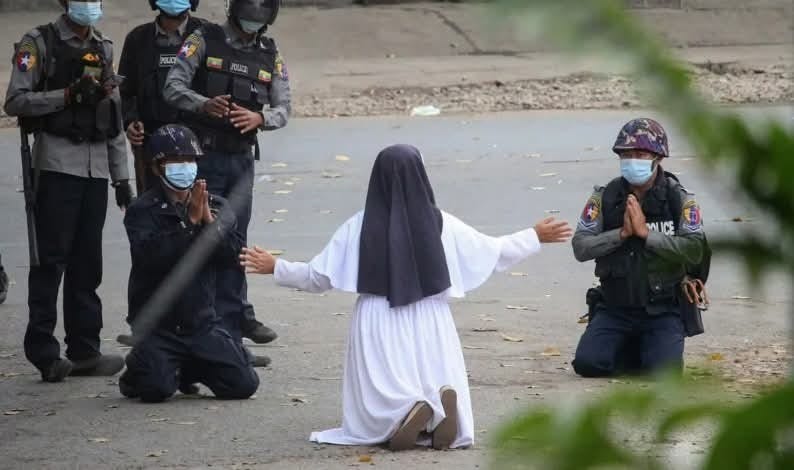
In this episode, we dive into the powerful and multi-layered responses of Burmese Christian communities navigating Myanmar’s ongoing political crisis. From the front lines of the pro-democracy movement to diaspora churches in the United States, faith has become both a shield and a catalyst for action. David Moe and Joe Cheah illuminate how both Protestants and Catholics are engaging in diverse forms of resistance. This spans from the beautiful “spiritual resistance” found in Indonesian/Malaysian gospel songs such as Kumau Cinta Yesus (I Want to Love Jesus), to radical acts of nonviolent protest—vividly captured in the globally symbolic image of a Catholic nun, Sister Ann Rose Nu Tawng, kneeling before armed police officers to protect protestors.
The conversation moves deeper to examine the complex biblical and theological frameworks driving these actions, exposing the internal tensions that arise when interpreting scriptures like Romans 13 during a violent military coup. We also trace the transnational impact of this political witness on Burmese immigrant churches in the US. Prior to the coup, these congregations predominantly focused on cultural preservation and community life. Today, they have transformed into crucial hubs for global advocacy, human rights awareness, and cross-ethnic collaboration. However, this heightened political involvement has brought deep generational and ideological fractures to light, prompting critical questions about the role of the church, the use of tithes for physical defense, and how the second generation navigates social justice in the diaspora.

Burma Christian Diaspora in Indianapolis: Celebrating Our Stories, Embracing Our Challenges
You are warmly invited to attend the 2026 Our Story, Our Faith (OSOF) Conference: Burma Christian Diaspora in Indianapolis: Celebrating Our Stories, Embracing Our Challenges, taking place August 7–8, 2026 in Indianapolis, IN, and online.
📍Dates: August 7–8, 2026
📍In-Person Location: Falam Baptist Church of Indiana in Indianapolis, IN
📍Virtual Attendance: Airmeet
Glossary
Adharma: A Sanskrit term meaning moral wrongdoing or evil. In the context of the Burmese political crisis, it represents the framework used by some Christians to define the military coup as an unjust entity that must be resisted.
Aung San Suu Kyi (b. 1945): A globally recognized Burmese politician, diplomat, author, and Nobel Peace Prize laureate. She served as the de facto head of government (State Counselling minister) prior to being deposed and arrested by the military during the February 2021 coup.
Chin State: A mountainous region in western Myanmar predominantly inhabited by the Chin people, an ethnic minority group that is overwhelmingly Christian. David Moe highlights Chin State as having one of the highest percentages of public servants who bravely refused to work under the military regime, leading the local Civil Disobedience Movement (CDM).
Civil Disobedience Movement (CDM): A massive, peaceful resistance campaign launched immediately after the 2021 military coup. It consisted of doctors, educators, engineers, and civil servants refusing to work under the junta to paralyze the regime’s administrative capabilities.
Dharma: A foundational term in Indian and Buddhist traditions broadly meaning moral order, righteousness, or the summary of Buddhist teachings.
Diaspora: Scattered communities of people who have been displaced or migrated from their original homeland. In this episode, it refers to Burmese Christian communities living and worshipping in the United States.
Kumau Cinta Yesus (I Want to Love Jesus): An Indonesian/Malaysian gospel song that has been cross-culturally adopted by Burmese Christians. Singing this specific song during times of intense political terror serves as a form of “spiritual resistance,” reinforcing absolute allegiance to Christ over a dictatorial regime.
MaBaTha (Patriotic Association of Myanmar): A powerful, nationalist Buddhist organization that rose to prominence in Myanmar during the 2010s. It has historically driven anti-Muslim sentiments, advanced a hardline pro-Buddhist political agenda, and contributed to the social marginalization of religious and ethnic minorities (including Christians).
Min Aung Hlaing (b. 1956): The senior general of the Myanmar Armed Forces (Tatmadaw) who orchestrated the February 1, 2021 coup, ousting the democratically elected government and subsequently installing himself as the leader of the ruling military junta.
Natural Law Tradition: A philosophical and theological framework asserting that certain moral rights and values are inherent in human nature. This tradition argues that unjust laws passed by human governments do not legally or morally bind a person’s conscience.
Ne Win (1911 – 2002): A military general who ruled Myanmar from 1962 to 1988 following a coup d’état. He established a totalitarian, isolationist regime under the banner of the “Burmese Way to Socialism,” which initiated decades of economic stagnation and systematic military dominance.
Romans 13 (1–7): A pivotal New Testament passage historically used to command absolute submission to governing authorities. In Myanmar, this text has sparked intense theological debate between literal submissionists and those who argue obedience is strictly reserved for just authorities.
Saffron Revolution (2007): A series of massive economic and political protests in Myanmar triggered by the military government’s decision to lift subsidies on fuel. The movement was named after the saffron-colored robes worn by thousands of Buddhist monks who led the nonviolent demonstrations, which were met with a severe, violent crackdown by the military junta.
Sister Ann Rose Nu Tawng: A Roman Catholic nun belonging to the Sisters of St. Francis Xavier in Myitkyina. She became a global icon of nonviolent bravery when photos and videos circulated of her kneeling in front of heavily armed police forces, begging them to shoot her instead of the young pro-democracy protestors.
Spiritual Resistance: The practice of using faith-based assets—such as prayer, humanitarian aid, scripture reinterpretation, and sacred music—to internally defy and publicly oppose oppressive political structures.
The 969 Movement: A nationalist movement led by extremist Buddhist monks in Myanmar. It uses numerical Buddhist symbolism to counter what it claims is the expansion of Islam, frequently stoking religious tensions and sporadic communal violence across the country.
Discussion Questions
The Limits of Submission: David Moe notes that while some Burmese Christians interpret Romans 13 literally to mean absolute submission to government, others read it in dialogue with Romans 12:9 (”hate what is evil; cling to what is good”) to justify resisting an unjust coup. How should Christians navigate passages on state submission when a government commits severe human rights abuses? Who decides when an authority has lost its legitimacy?
The Ethics of Sanctuary and Defense: The text highlights a controversial friction in diaspora churches regarding whether church tithes should be used to purchase weapons for local defense forces fighting the military regime. Where is the line between providing humanitarian aid (re-reading the Good Samaritan parable) and funding active physical defense, and how does a community maintain unity amidst such stark ethical divides?
The Evolution of Immigrant Ecclesiology: Prior to the political crisis, many Burmese diaspora churches in the US focused purely on community life, language, and cultural preservation. The crisis forced them to pivot into centers of political awareness and inter-ethnic collaboration. Should immigrant and minority churches inherently serve as political and social advocacy hubs, or should they focus strictly on spiritual and cultural sanctuary?

Fr. Joe Cheah, OSM, is Professor and Chair in Philosophy, Theology and Religious Studies at the University of Saint Joseph in West Hartford, Connecticut. As a part of the first wave of immigrants from Burma, he came to the United States with his parents in 1966. He co-sponsors the St. Mary’s Home in Kyauktan, Myanmar. All donations and inquiries go through our 501(c)(3) organization in the US: The Children Charitable Foundation of Myanmar, Inc. (childrenofmyanmar.org)
Joe has published extensively, including Race and Religion in American Buddhism: White Supremacy and Immigrant Adaptation (New York: Oxford University Press, 2011), Theological Reflections on “Gangnam Style”: A Racial, Sexual, and Cultural Critique (New York: Palgrave MacMillan, 2014) with Grace Ji-Sun Kim, and Anti-Asian Racism: Myths, Stereotypes, and Catholic Social Teaching (New York: Orbis Books, 2023). Joe can be reached at jcheah@usj.edu.
Dr. David Thang Moe is at Yale University in New Haven, CT. where he is a Postdoctoral Associate and Lecturer in Religion and Conflict at the Council on Southeast Asia Studies at MacMillan Center for International and Area Studies and Department of Religious Studies. He can be reached on Facebook at facebook.com/davidmoe83.
For more about Burmese American Christians, see David Thang Moe, “The Hidden Stories of Burmese American Christians: Understanding their Imagination of Identity,” International Bulletin of Mission Research 2024, Vol. 48(3), 383 –398.
This podcast series is funded by the APARRI Working Grant and the American Baptist Home Mission Societies.


Thanks for reading Pearl Dive, AACHI’s digital platform! This post is public so feel free to share it.